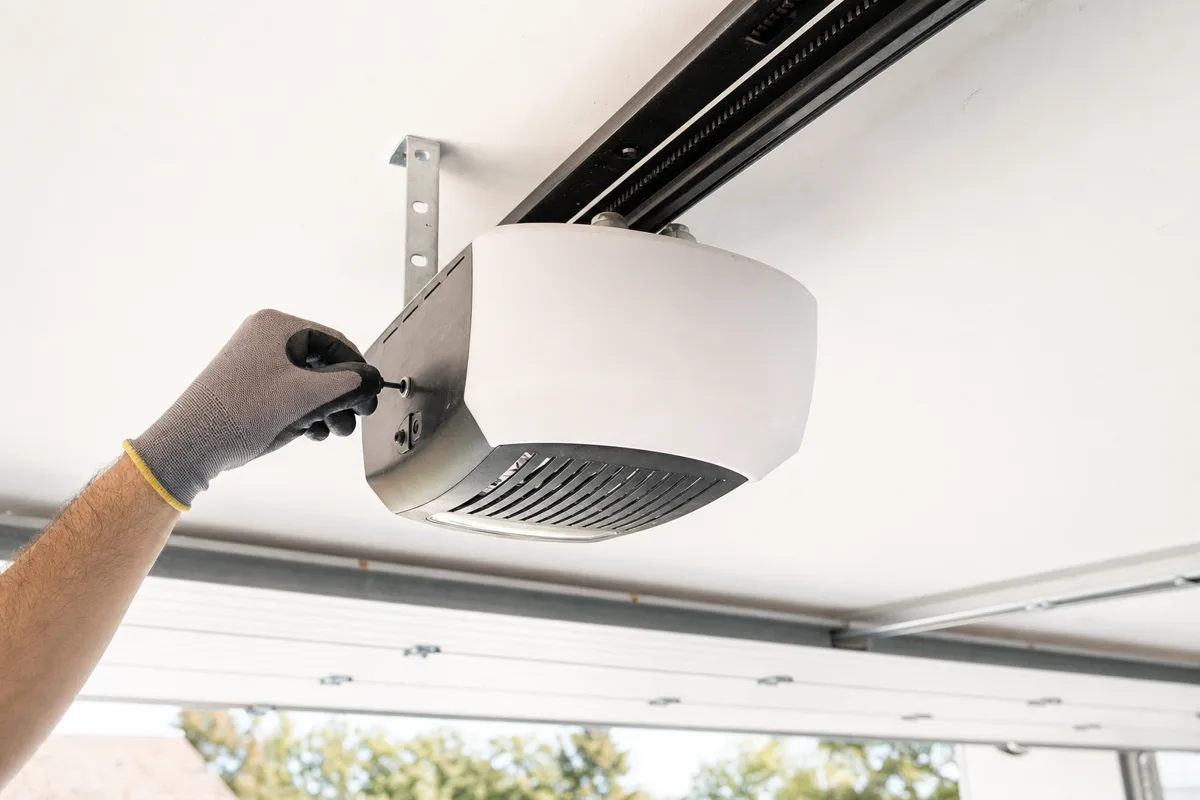

Garage Door Opener Installation
Operators sized to the door and fitted with tested safety reversal systems.
View detailsFault-finding on openers that hum, stall, reverse, or ignore their controls.

Opener faults divide neatly into three groups: the operator itself, the safety and control circuits attached to it, and the door it is trying to move. Diagnosis has to establish which group is responsible before parts get changed, because a straining motor on a badly balanced door is a symptom rather than the fault. Send the booking form with the drive type, roughly how old the unit is, and what the lights and beeps are doing.
Residential openers commonly give something in the range of ten to fifteen years of service, with belt drives typically running quieter for longer than chain or screw drives. Individual parts such as gears, sensors, capacitors and logic boards can be replaced well before the unit as a whole is finished. The practical turning point is when parts availability, repeated faults, or the absence of modern safety and security features start to outweigh the cost of repair.
Work through the symptom first — some of these turn out to need no technician at all.
A stripped drive gear, a slipping belt, a worn chain or a failing trolley lets the motor spin without transmitting movement. Screw-drive units suffer where the rail has gone dry. The tell is a motor that sounds normal while the door stays still.
Paired sensors near the floor must see each other for the door to close. Dirty lenses, a nudged bracket, a damaged wire, or low winter sun striking the receiver all break that agreement. The opener then reverses, flashes, or insists on hold-to-run closing.
Limits tell the opener where the floor and the fully open position are; force settings tell it how much resistance is acceptable. When either drifts, the door stops short, reverses near the floor, or presses too hard. Raising force to mask real drag is how minor faults become expensive ones.
A door out of balance, a seized roller or a bent rail all raise the resistance the opener sees. A perfectly healthy operator will stop, reverse or overheat rather than push through it. Replacing the opener in that situation buys a new unit and the same fault.
Bramalea gives Brampton an unusual concentration of late-1950s-onward housing, laid out from a 1958 master plan as Canada's first satellite community developed by a single major developer, with its lettered sections running from A through P. Peel Village, launched in 1961, adds another large block of that era. Garages in these neighbourhoods have often been through several generations of operator, sometimes on original wiring and original header framing. Older installations are also where pre-photo-eye retrofits and mismatched remotes show up most often, so the control side of the diagnosis matters as much as the motor.
Disconnect power before working near the motor head, and never bypass, tape over, or disable the photo-eye sensors, even temporarily. Do not increase force settings to overcome a door that drags; that removes the protection the setting exists to provide. Keep the door in view during any test cycle and keep children away from the wall control. If the door reverses unpredictably, stop using it and book service.
The door is disconnected and moved by hand to see how much of the complaint belongs to the operator at all. A door that is heavy, sticky or unbalanced by hand changes the whole diagnosis before a single opener part is considered.
Sensor alignment, lens condition, wiring and indicator behaviour are checked, along with the wall control, keypad and remote programming. Diagnostic light and beep codes are read against the manufacturer's reference rather than guessed at.
Gears, belt or chain tension, the rail, the trolley, the arm and the motor mount are examined for wear, play and heat damage. The header bracket and ceiling mounts are checked too, since a shaking rail is often a mounting problem rather than a drive problem.
After the repair, travel limits and force settings are set for the door's actual weight and the contact-reverse and photo-eye reverse tests are both performed. Remotes and keypads are re-verified before the visit closes.
Operators sized to the door and fitted with tested safety reversal systems.
View details
Balance test, hardware torque, lubrication and a full safety-system check.
View details
Seized rollers renewed, bent rails corrected, derailed doors re-railed and squared.
View detailsFill out the form and we'll confirm your appointment by email.
Garage Door Opener Repair is available across every Brampton neighbourhood inside the area below.
Map data © Google. Pin shows the service area, not a walk-in location — all work is done at your home.

A real callout, not stock imagery.
A sectional door pulled off its tracks, taken down and supported on site so it could be checked and re-hung safely — photographed on the job.