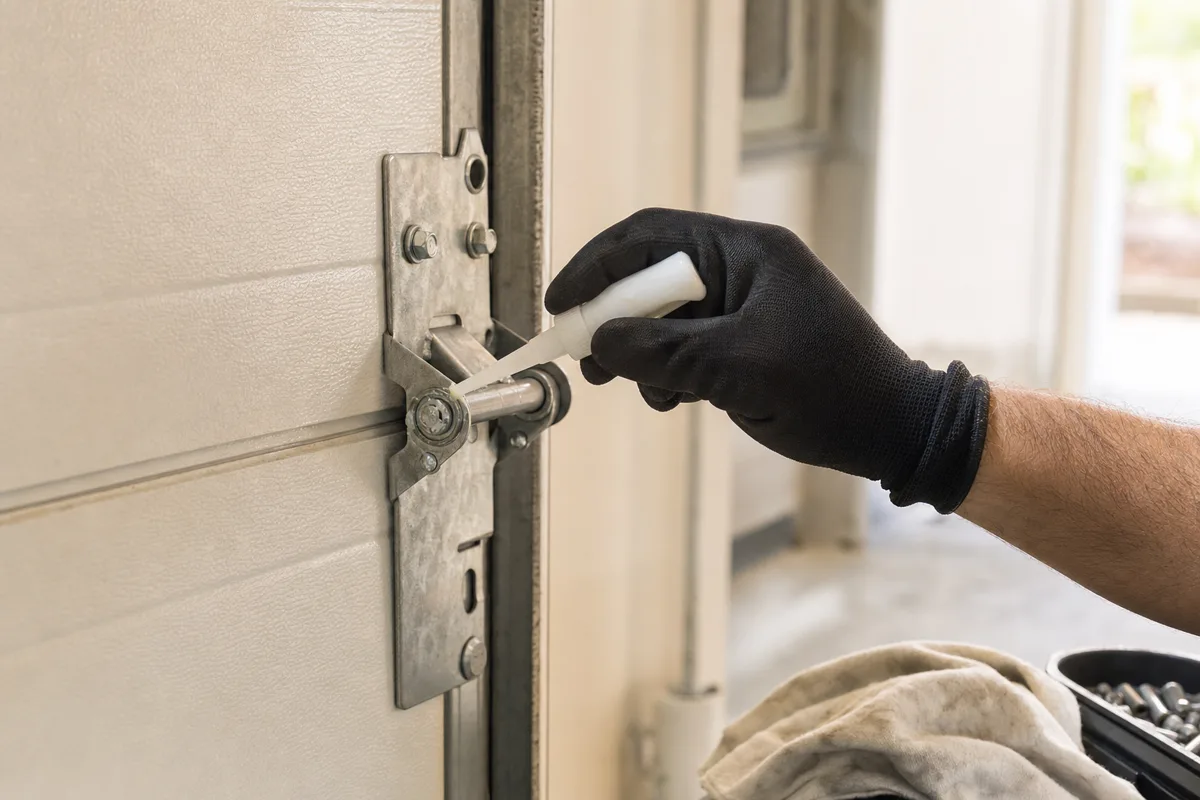

Garage Door Roller & Track Repair
Seized rollers renewed, bent rails corrected, derailed doors re-railed and squared.
View serviceEvery garage door makes some sound. A new one — a scrape, a rattle, a squeal, a bang — is information. Where in the travel it happens is usually the most useful clue you have.
Loud garage-door noise most often traces to worn rollers, loose hinge or bracket hardware, dry pivot points, or a door rubbing where its track clearance has drifted. Note exactly when in the cycle the sound occurs, then inspect the visible hardware with the door fully down. Stop using the door if it grinds, bangs, jerks or pulls to one side, because those symptoms involve components carrying the door's weight.
Noise becomes diagnosable once you can describe two things: when it happens and what it sounds like. A light recurring squeak tends to come from a dry pivot. Scraping suggests something is in contact that should not be. A single sharp bang, a sudden shudder, or a motor that audibly labours deserves a much more cautious response than a squeak does. Watch one controlled cycle from the side, well clear of the door, rather than sending repeated commands to gather more data. Do not stand beneath the door, reach into a track, or put a hand near a hinge while anything is moving. A healthy door travels in a steady line without violent shaking, rollers jumping their guides, or an operator straining. If the noise arrives together with uneven motion, treat the door as out of service and arrange an assessment instead of continuing to investigate.
Start at the top. The early checks are the most common causes and need no tools.
From the side and at a safe distance, watch one complete cycle. Decide whether the noise starts as the door breaks from the floor, follows it through the curved section, occurs near full open, or comes from the motor head itself. If the sound is severe, do not repeat the test — one observation is enough.
What it means: A noise tied to one point in travel usually points at hardware near that point.
Check that no ladder, hose reel, hook, storage bin, bicycle or hanging cord makes contact with the door, either track, or the opener rail. On the inside face of the closed door, look for a loose handle, lock bar or panel reinforcement that could rattle. Adjacent contact often sounds exactly like a failing roller.
What it means: If removing a nearby object silences the door, the hardware may be fine.
With the door fully closed, use a flashlight to look for split roller wheels, a wheel that wobbles on its stem, a missing or bent stem, worn hinge leaves, and dark metal dust beneath any roller. Keep your fingers outside the track. Each roller should sit seated in its guide rather than riding an edge.
What it means: Cracking, visible wobble or metal dust identifies a roller or hinge that needs replacing.
Look only for hinge and support-bracket fasteners that are plainly backed out. Do not tighten anything at the bottom brackets, cable drums, spring anchor, or track mounting points, because those carry load or set the door's alignment. Write down what you see so it can be dealt with properly.
What it means: Loose hinge hardware rattles; tensioned or alignment-critical fasteners are a technician's job.
During one observed cycle, watch whether the opener rail shakes noticeably and listen for clicking, grinding, or a motor that hums without moving the door. Belt and chain drives have their own normal sound, so what matters is a change from what you are used to. Stop if the opener is clearly straining.
What it means: A labouring opener is usually reacting to door resistance rather than failing on its own.
Stop using a noisy door if there is a loud impact sound, harsh grinding, a sudden shake, or any visible change in the path it travels. Do not assume lubricant will fix a cable, spring, roller or track defect — it will only mask it briefly. Never adjust spring hardware or bottom brackets, and never try to straighten a rail with hand tools while the door is loaded. Leave the door down where practical, keep the opening clear, and use the online form to book an inspection.
Brampton sits inside a dense arterial network — Highway 410 north to the 401, Highway 407 along the south, Queen Street, Bovaird Drive, Steeles Avenue and Main Street — all of them heavily treated through winter. With roughly 44.7 days of measurable snowfall in an average year, de-icing brine and grit ride home on tires and dry out on the garage floor. The residue settles on the lowest steel components: rollers, hinges, bottom brackets and the lower track channel. That is corrosive and abrasive at once, and it turns a roller that was silent in November into a scrape by February. A new noise appearing near the bottom of the travel after a salty stretch of driving is a good reason to look for grit and a wheel that no longer spins freely.
Fill out the form and we'll confirm your appointment by email.
These guides are written for Brampton homes. If the fix is beyond a homeowner check, we work everywhere inside this area.
Map data © Google. Pin shows the service area, not a walk-in location — all work is done at your home.

A real callout, not stock imagery.
A sectional door pulled off its tracks, taken down and supported on site so it could be checked and re-hung safely — photographed on the job.
