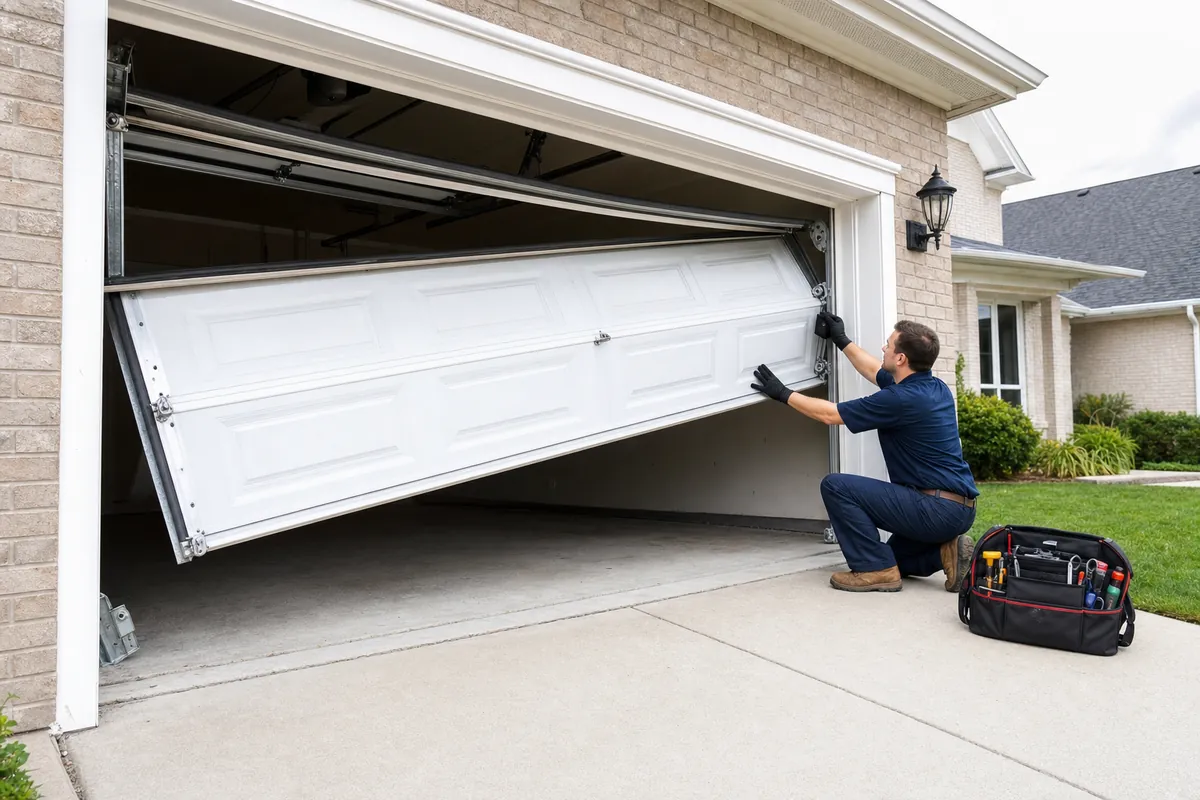

Emergency Garage Door Repair
Urgent attention for doors stuck open, jammed part-way, or hanging crooked.
View serviceA door bonded to the concrete by overnight ice is a common Brampton winter problem and an easy one to make worse. The opener is not the tool for the job.
Do not hold the button down. Shovel snow and slush clear of the full threshold, then work the ice away from the bottom seal with a plastic tool or warm water applied sparingly and immediately dried or cleared so it does not refreeze. Never use an open flame, and never pry at the rubber with metal. Once the seal releases, run one slow cycle and check that the seal is intact and the door sits level. If it will not release, leave it and book service.
Freezing happens at the interface between the bottom weatherseal and the slab. Meltwater or rain runs toward the garage during the day, the temperature drops through the freezing point overnight, and by morning the rubber is locked to the concrete. The drive system may be in perfect condition and the door still will not move. What determines whether this becomes a repair is what happens in the next thirty seconds. An opener asked to lift a door that is glued down will either trip its overload, strip a gear, bend its arm, or tear the seal off the bottom section. Patience costs nothing. Work at the ice mechanically and gently, from outside, and give the seal a chance to release. If the door frees but then behaves oddly — reversing, scraping, or sitting unevenly — treat that as a separate fault to be looked at rather than something the thaw will sort out.
Start at the top. The early checks are the most common causes and need no tools.
From outside, look along the bottom edge for a continuous line of ice, frozen slush, or a visible bond between the rubber and the concrete. Compare both corners. If the seal looks clear and the door still will not move, the problem is more likely a spring, cable or opener fault than the weather.
What it means: Visible ice along the seal line confirms a freeze; a clear seal points elsewhere.
Shovel loose snow and slush away from the whole width of the doorway and a short distance out onto the driveway. Snow banked against the door keeps feeding meltwater to the seal and can also physically block the door's path. Clear the drainage route away from the slab, not just the line at the door.
What it means: Removing the snow load sometimes releases the door on its own.
Use a plastic scraper or a rubber mallet handle to work along the seal, chipping ice away from the rubber rather than levering against it. Warm water can help if it is used in small amounts and cleared away immediately so it does not refreeze into a thicker layer. Do not use a torch, heat gun, or metal blade.
What it means: A seal that lifts freely along its full width is ready for one test cycle.
Send a single open command and watch closely. If the door rises evenly, let it complete the cycle. If it strains, groans, judders, lifts on one side, or stops, cancel immediately and go back to clearing ice. Do not make repeat attempts hoping for a different result.
What it means: Even, unstrained travel means the bond has released; anything else means it has not.
With the door open, check the bottom weatherseal along its length for tears, sections pulled out of the retainer, or missing pieces left frozen to the slab. Look at the concrete for a low spot where water pools. Both findings explain why the door froze and predict that it will do so again.
What it means: A damaged seal or a pooling threshold needs attention before the next cold night.
Never use an open flame, propane torch, or heat gun near a garage door: the seal, the finish and nearby framing are all flammable or heat-sensitive. Do not hold the opener button down to force a frozen door, and do not raise the force setting to get through it — that is how gears strip and arms bend. Do not pry at the seal with a screwdriver or ice chisel. If the door will not release with gentle mechanical work, leave it closed and use the booking form.
This is a genuinely local problem. Brampton averages 114.5 centimetres of snow across roughly 44.7 days with measurable snowfall, and January runs a daily mean near minus five degrees with mean daily minimums close to minus nine — cold enough to refreeze meltwater every night, mild enough by day to keep producing it. Inland parts of the surrounding area run colder and snowier still; the Georgetown record to the northwest shows a January mean near minus six and average snowfall around 136 centimetres. The mechanism that matters is the crossing itself: moisture absorbed into materials expands and contracts as the temperature passes through freezing, and that repeated mechanical action is what degrades seals, fasteners and low hardware. It is the combination of moisture with freezing and thawing, not cold on its own, that does the damage.
Fill out the form and we'll confirm your appointment by email.
These guides are written for Brampton homes. If the fix is beyond a homeowner check, we work everywhere inside this area.
Map data © Google. Pin shows the service area, not a walk-in location — all work is done at your home.
A real callout, not stock imagery.
A sectional door pulled off its tracks, taken down and supported on site so it could be checked and re-hung safely — photographed on the job.
