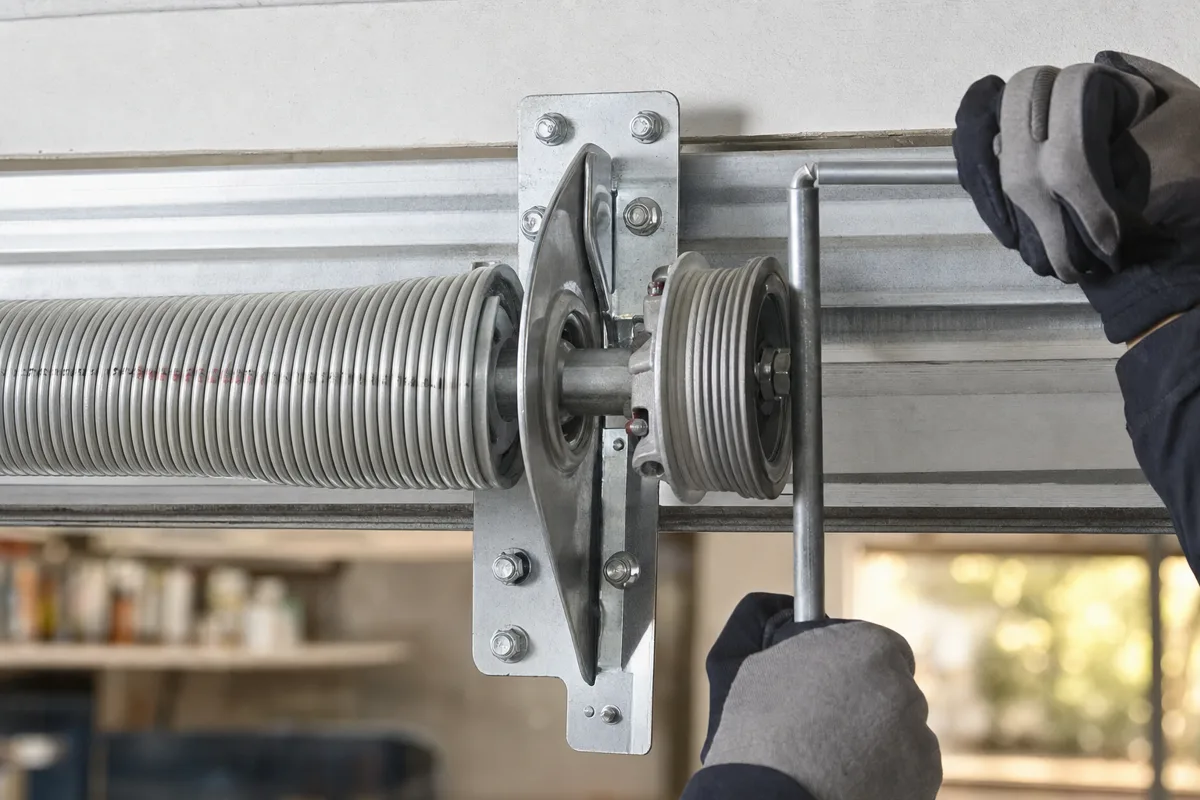

Garage Door Spring Replacement
Fractured torsion and extension springs replaced with correctly matched sets.
View serviceA broken torsion spring is one of the few garage door faults that changes everything at once. The evidence is usually plain if you know what to look for — and the correct response is to stop using the door.
Look for a visible gap of a few centimetres in an otherwise continuous coil on the shaft above the door, a loud bang with no obvious cause, a door that suddenly feels immovably heavy, or an opener that strains and gives up after a short lift. On a two-spring door, one broken spring is enough to take the door out of service. Do not try to lift it by hand and do not keep running the opener — leave the door closed and book a replacement.
Springs, not the opener, carry the weight of a garage door. The operator only overcomes friction and provides direction; the counterbalance does the lifting. When a torsion spring fractures, that support disappears in an instant and the door becomes something the opener was never designed to move. Most households hear it happen: a loud bang from the garage, often with nobody near the door. Others discover it the next morning when the opener strains, clicks, or lifts the door a few centimetres before it slides back down. The checks below are all observational, done with the door closed and from a safe position. None of them involve touching the spring, the cables, the drums or the bottom brackets, and none of them should be extended into an attempt at repair. A broken spring leaves a lot of stored energy and unsupported weight in the assembly.
Start at the top. The early checks are the most common causes and need no tools.
Stand back from the closed door and look at the shaft mounted above the opening. A torsion spring in one piece has evenly spaced coils along its whole length. A broken one shows a distinct gap, usually two to five centimetres, where the steel has separated. Use a flashlight rather than getting close to the assembly.
What it means: A clear gap in the coil is a definitive broken spring — stop using the door.
Ask whether anyone heard a single loud bang or crack from the garage, possibly overnight or while nobody was in the room. Spring fractures release a great deal of energy at once and are frequently mistaken for something falling off a shelf. The timing usually lines up with when the door stopped working.
What it means: An unexplained bang followed by a door that will not lift is a strong indicator.
From a clear position, send one open command and watch what happens. A door with a failed spring typically does one of three things: nothing at all while the motor runs, a short lift followed by a slide back down, or a strained partial travel with obvious motor effort. Do not send a second command.
What it means: A motor working hard for little or no movement points at lost counterbalance.
Only if the door is fully closed and visibly undamaged, and only with the opener disconnected, test the handle with a light pull to sense whether the door feels normal or startlingly heavy. Do not lift it, do not hold it above the floor, and do not put your body under it at any point.
What it means: A door that feels far heavier than usual has lost spring support and should be left closed.
Look at both lift cables and both bottom corners of the closed door. After a spring failure a cable can go slack or unwind from its drum, and one corner may sit lower than the other. Note what you see and keep well clear of the hardware while you look.
What it means: Slack cable or a dropped corner means additional damage beyond the spring itself.
A broken spring leaves the door's full weight resting on hardware not designed to hold it alone. Do not lift the door manually, do not run the opener to see whether it copes, and do not remove or adjust cables, drums, bottom brackets or winding cones. Torsion springs require proper winding bars and technique; improvised tools cause serious injuries. Park outside, keep children and pets out of the garage, leave the door down, and submit the booking form describing what you observed.
Brampton's housing stock is heavily weighted toward the building waves of the 1990s through the 2010s in Springdale, Fletcher's Meadow, Mount Pleasant, Castlemore and Credit Valley, and 52.6 per cent of the city's 182,470 occupied private dwellings are single-detached houses. Almost all of that newer stock carries a wide two-car door: the City's design guidelines allow around 5.0 metres of cumulative door width on a lot between 11.6 and 12.5 metres of frontage, and about 5.5 metres between 12.5 and 14.0 metres. Wide doors are heavy doors, and heavy doors are unforgiving of a spring reaching the end of its cycle life. Many original springs fitted during those waves are now well inside the window where failure is expected.
Fill out the form and we'll confirm your appointment by email.
These guides are written for Brampton homes. If the fix is beyond a homeowner check, we work everywhere inside this area.
Map data © Google. Pin shows the service area, not a walk-in location — all work is done at your home.

A real callout, not stock imagery.
A sectional door pulled off its tracks, taken down and supported on site so it could be checked and re-hung safely — photographed on the job.
