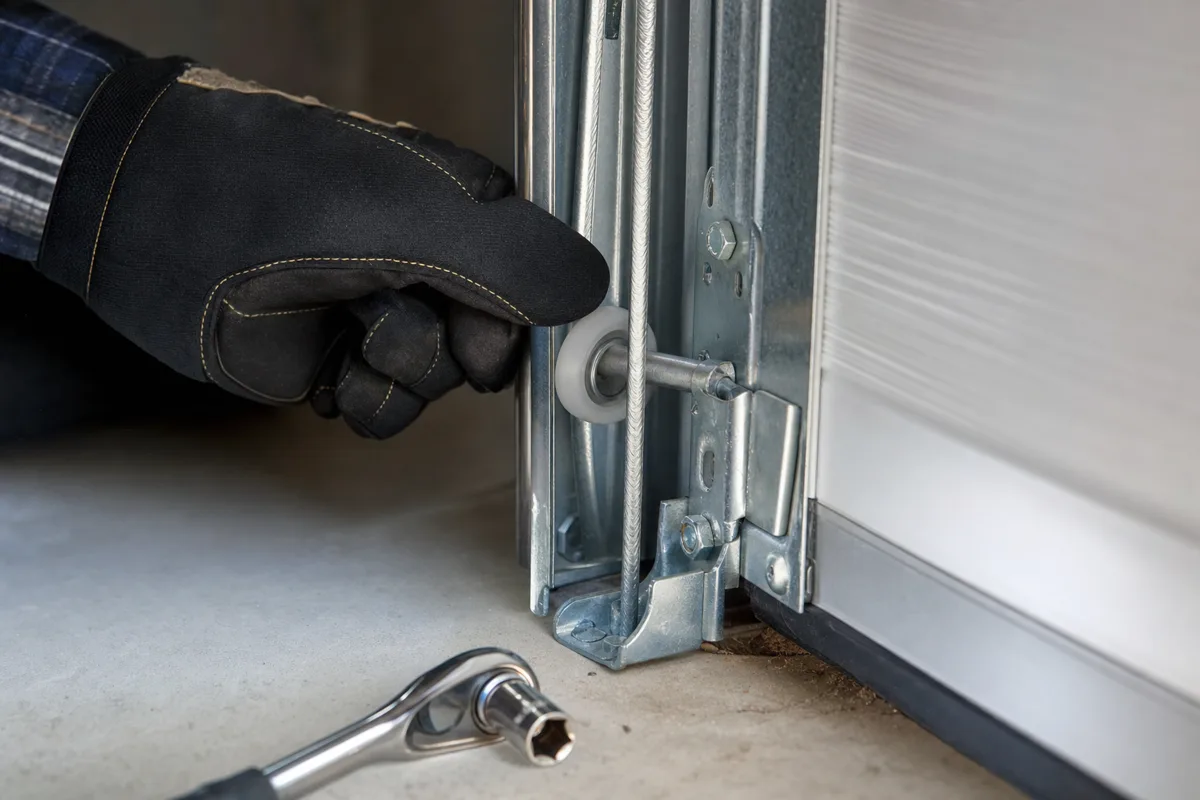

Garage Door Roller & Track Repair
Seized rollers renewed, bent rails corrected, derailed doors re-railed and squared.
View serviceA door out of its rail is being held in a way nothing was designed for. It can move suddenly. The right first action is to stop, not to correct.
Stop using the opener immediately and keep everyone and every vehicle out from under the door. Do not try to lever, hammer or lift the door back into its rail: the springs and cables may be unevenly loaded and the door can drop. Note which side and which roller left the track, whether a cable is slack, and whether any rail section is visibly bent, then request service through the online form and leave the door where it is if that is safe.
Off-track is the outcome, not the cause. A door leaves its rail because something upstream changed: a roller collapsed, a cable unwound, a bracket loosened, the door closed onto an obstruction, or a vehicle struck the vertical track. Once it is out, the load path through the cables, springs and brackets is no longer the one the manufacturer intended, and the door can shift without warning. That is why the checks in this guide are all observational and why none of them involve moving the door. The value in looking carefully is that the observations you make now — which corner, which roller, whether a cable is slack, where the rail is bent — determine what needs to be brought to the repair. Take a photograph if you can do it safely from outside the opening. Then leave the garage alone and get the door back in properly.
Start at the top. The early checks are the most common causes and need no tools.
Do not send any further commands to the opener. Move vehicles out from under the door if that can be done without passing beneath it, and keep children and pets out of the garage entirely. If a car is trapped, leave it rather than driving it out under a door that could move.
What it means: Containing the area is the only correct first action for an off-track door.
From outside the opening and at a safe distance, work out which side of the door has left its rail and roughly which roller is out — top, middle, or bottom. Note whether the door is sitting square or leaning, and whether it is resting against the frame or the opener rail.
What it means: Knowing which roller and which side is out shapes the repair before the visit.
Check both lift cables from a distance. A cable hanging loose, bunched on its drum, or clearly slacker than its partner tells you the counterbalance is no longer working evenly. Do not touch, pull, or try to re-seat a cable under any circumstances.
What it means: A slack cable means uneven load and a door that can move unexpectedly.
Look at the torsion spring on the shaft over the door for a visible gap in the coil. An off-track door and a broken spring often occur together, either because the spring failure caused the derailment or because the derailment overloaded the spring assembly.
What it means: A gapped coil alongside a derailed door means two failures to repair, not one.
Look at the threshold and the lower vertical tracks for what the door may have closed onto, and for dents, kinks or bright scrapes that suggest an impact. A crushed bin, a snow ridge, or a bumper mark is often the whole explanation.
What it means: Finding the cause prevents the same derailment happening again after repair.
Do not attempt to lift, lever, hammer or pull an off-track door back into its rail. Springs and cables may be loaded unevenly and the door can fall or swing. Do not remove rollers, loosen track brackets, or unbolt bottom fixtures, and do not run the opener to see whether it will pull the door straight. Keep the opening clear, do not walk beneath the door, and submit the booking form with a description of which side is out and whether a cable is slack.
Brampton's post-1990 subdivisions were built to narrow frontages with garage-forward elevations, and the City's own guidelines note that garages and driveways visually dominate those streetscapes while capping garage width at half the house frontage. On single-car townhouse driveways limited to about 2.75 metres, and on the paired or shared driveways common through Springdale and Fletcher's Meadow, bins, bikes and shovelled snow end up close to the door opening. Closing a door onto any of those is one of the most reliable ways to put a cable off its drum and a roller out of its rail. In the Mount Pleasant block plan area, where garages open onto rear lanes, the paved aprons are tighter still and collect slush against the bottom fixtures.
Fill out the form and we'll confirm your appointment by email.
These guides are written for Brampton homes. If the fix is beyond a homeowner check, we work everywhere inside this area.
Map data © Google. Pin shows the service area, not a walk-in location — all work is done at your home.

A real callout, not stock imagery.
A sectional door pulled off its tracks, taken down and supported on site so it could be checked and re-hung safely — photographed on the job.