
Garage Door Spring Replacement
Fractured torsion and extension springs replaced with correctly matched sets.
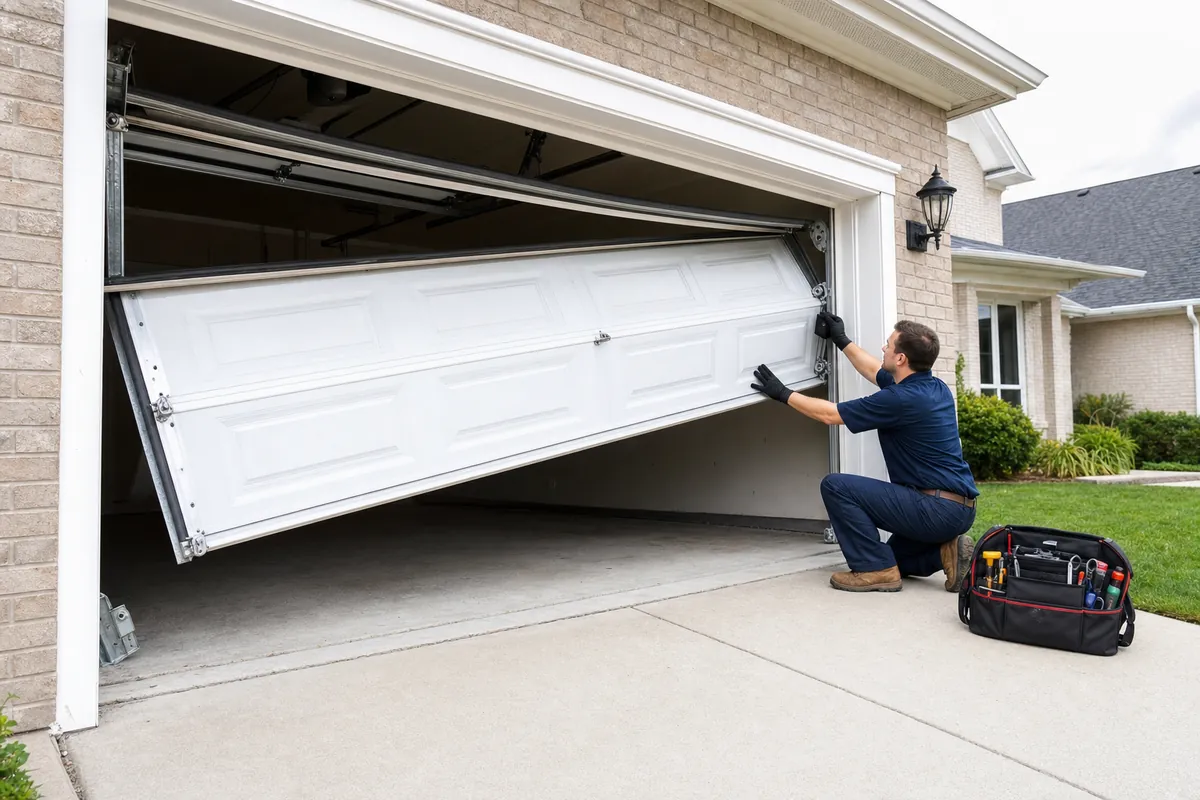
View detailsUrgent attention for doors stuck open, jammed part-way, or hanging crooked.

Some garage door faults can wait for a convenient morning. A door hanging crooked over a car, a door that stopped halfway and will not budge, or a door that cannot be secured at the floor cannot. Those are containment problems first and mechanical problems second: the opening has to be made safe before anyone starts diagnosing why the lift system stopped carrying the weight it is supposed to carry. Send the booking form with a plain description of what the door is doing and what it is sitting over.
An emergency visit is about the part that failed, not a verdict on the whole door. A sensor fault, a split roller or a torn weatherseal can be isolated while everything else stays serviceable. A broken torsion spring is a different category: standard residential springs are commonly rated for about 10,000 cycles, which for an everyday household door tends to work out somewhere in the range of seven to twelve years. Condition, balance and how often the door is used matter far more than the calendar.
Work through the symptom first — some of these turn out to need no technician at all.
Springs, not the opener, carry the weight of a residential garage door. Once a torsion spring fractures or loses working tension, the opener is being asked to lift a load it was never sized for. It may hum, buzz, trip its overload, or drag the door up a few centimetres and stop. Until the spring is dealt with, nothing about the door's weight can be assumed.
A cable can unwrap after a roller seizes, a track shifts, or the door gets pulled up out of square. From that moment one side of the door is lifted and the other is dragged. Running the opener again usually widens the damage into bent hinges, a crushed track flange, or a section that no longer sits flush with its neighbour.
A dented rail, a collapsed roller, a bin knocked into the opening, or packed snow at the threshold all read to the opener as resistance. Openers respond by stopping or reversing, which is the correct behaviour. Overriding that response with repeated attempts turns a small guide fault into an off-track door.
Meltwater running toward a Brampton garage slab refreezes overnight and glues the bottom seal to the concrete. The drive system can be in perfect order and the door still will not move. Forcing it tears the seal, bends the opener arm, or strips the trolley.
Brampton averages 114.5 centimetres of snow across roughly 44.7 days with measurable snowfall each year, and January runs a daily mean near minus five degrees. The important part is not the depth but the crossings: daytime melt runs toward the slab, night refreezes it, and that repeated cycling of moisture through freezing is what does mechanical work on a door's lowest components. Clear loose snow and free the seal gently before touching the wall button. Cold also exposes a roller or spring that was already close to the end of its life, so a January call often has two causes rather than one.
Do not force an emergency door in either direction. Keep children, pets and vehicles out from under a door that is part-raised, leaning or hanging on one cable. Do not pull on a cable, lever a roller back into its rail, or release the opener from a door whose spring condition is unknown; any of those can let a heavy door drop or release stored energy. If the opening cannot be left safely, clear the area and send the online form.
The first question is whether the door can shift on its own. Its position, the state of both cables and the condition of the bottom brackets decide what happens next. Where it is safe, the opener is taken out of the loop so it cannot pull against a door that is heavy, twisted or unsupported.
Springs, the shaft, both drums, both cables and the bottom fixtures get checked as one assembly. That establishes whether the emergency started in the counterbalance or whether the counterbalance simply reacted to a mechanical failure somewhere else. It also flags impact damage that would matter once the door is moving again.
Rails, rollers, hinges, brackets and every section are inspected end to end. The loudest symptom is often not the origin: a loose cable is frequently the consequence of a roller that failed several cycles earlier. Checking the whole path avoids fixing the visible half of a two-part failure.
Once the cause is corrected the door is cycled by hand through its full range, checked for balance at mid-travel and checked for even contact along the floor. Only then is the opener reconnected, its travel limits confirmed and its safety reverse tested.
Fractured torsion and extension springs replaced with correctly matched sets.
View details
Slack, frayed or unwrapped lift cables renewed and rewound on the drums.
View details
Seized rollers renewed, bent rails corrected, derailed doors re-railed and squared.
View detailsFill out the form and we'll confirm your appointment by email.
Emergency Garage Door Repair is available across every Brampton neighbourhood inside the area below.
Map data © Google. Pin shows the service area, not a walk-in location — all work is done at your home.